

How to Play Chess: Rules, Piece Moves and a Plan for Beginners
Reviewed by Lena Govedarica, WIM, FIDE International Arbiter and chess coach. Last updated: November 2026.
Short answer: chess is a 2-player game on an 8x8 board. Each side starts with 16 pieces: 1 king, 1 queen, 2 rooks, 2 bishops, 2 knights and 8 pawns. White moves first, players take turns, and you win by checkmating the enemy king: attacking it so it has no legal way to escape.
That's the whole goal. Everything else is how you get there.
This guide covers 3 things in order:
- The rules: board setup, how every piece moves, the special moves and how to checkmate.
- How to actually learn: the order we recommend, from short lessons to your first real games.
- When you need a human coach: and why it's later than most people think.
If you already know the rules and keep losing anyway, skip to the beginner plan below.
How do you set up a chessboard?
Place the board so each player has a light square in the bottom-right corner. Then set the pieces:
- Back row, from the corners in: rook, knight, bishop.
- The 2 middle squares: queen on her own color (white queen on the light square, black queen on the dark one), king next to her.
- Second row: all 8 pawns.
The two kings face each other on the same file. So do the queens. If your queen isn't on her color, you'll be playing a slightly wrong game for a long time.
How does each chess piece move?
Every piece moves differently, and every piece except the knight is blocked by anything standing in its way. You capture by moving onto a square occupied by an enemy piece. The point values are a beginner's guide to trades, not a law.
| Piece | How it moves | How it captures | Value |
|---|---|---|---|
| Pawn | 1 square forward. 2 squares on its first move. | 1 square diagonally forward | 1 |
| Knight | In an L: 2 squares one way, then 1 square sideways. Jumps over pieces. | Same as it moves | 3 |
| Bishop | Any number of squares diagonally. Stays on its starting color all game. | Same as it moves | 3 |
| Rook | Any number of squares in a straight line, up, down or sideways. | Same as it moves | 5 |
| Queen | Any number of squares in any direction: rook and bishop combined. | Same as it moves | 9 |
| King | 1 square in any direction. Can never move into check. | Same as it moves | The game |
How does the knight move?
The knight is the piece beginners get wrong most often, so here's the trick: a knight always lands on the opposite color from where it started. From a light square it goes to a dark one, every time. It's also the only piece that jumps, which is why a knight can move before any pawn does.
How does the rook move?
Straight lines only, as far as the path is clear. Rooks are weak in the opening because they're boxed in, and very strong in the endgame when the board opens up. Get them onto open files (columns with no pawns) and they start doing real work.
Why can't the pawn capture straight ahead?
Because pawns move forward but capture diagonally. A pawn with a piece directly in front of it is stuck.
What are the special moves in chess?
There are 3. Most new players learn them the hard way, usually mid-game, usually from an opponent.
- Castling. The king moves 2 squares toward a rook, and the rook jumps to the square on the king's other side. It's the only move where 2 pieces move at once. You can castle only if: neither piece has moved yet, no pieces stand between them, your king isn't in check, and the king doesn't pass through or land on an attacked square. Castle early. A king in the center is a target.
- Pawn promotion. A pawn that reaches the last row turns into a queen, rook, bishop or knight. Almost always a queen. Yes, you can have 2 queens.
- En passant. If an enemy pawn moves 2 squares forward and lands right beside your pawn, you can capture it as if it had moved only 1. You must do it on the very next move or the chance is gone.
What's the difference between check, checkmate and stalemate?
- Check: your king is attacked. You must get out of it on your next move: move the king, block the attack, or capture the attacker.
- Checkmate: your king is attacked and none of those 3 options exist. Game over.
- Stalemate: it's your turn, your king is not in check, and you have no legal move. That's a draw, not a win. Beginners throw away winning positions this way every day, usually with an extra queen on the board.
Games can also end in a draw by agreement, by the same position repeating 3 times, or when neither side has enough pieces left to checkmate.
How do you checkmate in chess?
Learn these 4 patterns first. You'll use them, or get caught by them, in a lot of your early games.
- King and queen vs king. Use your queen to shrink the enemy king's box, one row at a time, until it's on the edge. Bring your own king close. Then deliver mate with the queen next to the enemy king, protected by your king. Watch for stalemate at every move.
- King and rook vs king. Same idea, slower. The rook cuts off a row or column, your king takes away the escape squares, and the rook delivers mate on the edge.
- Back-rank mate. A rook or queen checks the king on its back row while the king's own pawns block its escape. The fix costs one move: push a pawn in front of your castled king and give it some air.
- The 4-move mate (Scholar's Mate). The queen and bishop team up on f7 (or f2 for Black), the weakest square at the start because only the king defends it. Learn it to defend against it, not to play it. It works against beginners and backfires against anyone who's seen it before.
How to learn chess as a beginner
Knowing the rules and playing chess are 2 different skills. Most people learn the first in an afternoon and then lose 20 games in a row trying the second. Here's the order that works, and where each step lives on Outpost Chess.
Step 1: Take short lessons on the basics
Start with bite-sized lessons, one idea each: how the pieces move, how the rook works, how the knight jumps, how to castle, how to checkmate with a queen. Outpost Chess Lessons are built exactly like this, a few minutes each, with a quick check at the end so you know it stuck. Do one a day. It's faster than reading a rulebook, and you'll actually remember it.
Step 2: Play bots, then ask your AI chess coach why you lost
Your first games should be against AI bots set to a weak level, not against people. A bot doesn't get bored while you think, doesn't trash-talk, and you can play it as often as you like.
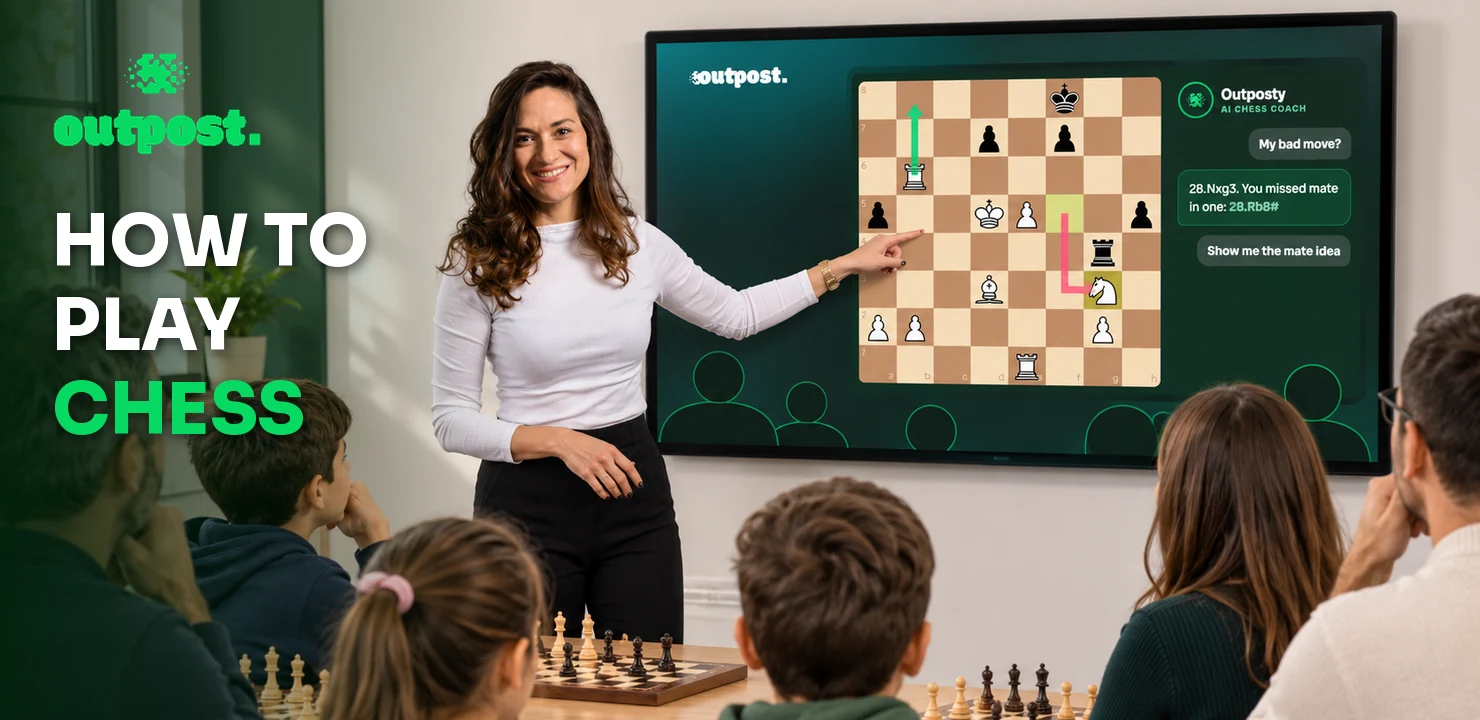
The important part comes after the game. On Outpost Chess, Outposty, the AI chess coach, reviews your game and you can chat with it about any move: "Why was that a blunder?" "What should I have played?" "Why is the knight better there?" You get a plain-language explanation of the idea, not just an engine number. Outposty is available any time, at 2 a.m. or on your commute, and answers in your language.
"Beginners don't lose because they don't know enough openings. They lose because they blunder a piece and nobody tells them why. An AI coach that explains every mistake, right after the game, fixes that faster than anything I've seen." Lena Govedarica, WIM and chess coach
Step 3: Learn 1 or 2 openings, not 20
Openings matter less than beginners think, and the ones you do learn should come with the plan, not just the moves. The Openings section on Outpost Chess has an openings library where you learn the main line, the ideas behind each move, and then test yourself. Pick one opening for White and one defense for Black and stick with them for a few months. More on that in how to learn chess openings with an AI coach.
Step 4: Train tactics with AI puzzles
Most games at the beginner level are decided by a tactic: a fork, a pin, a piece left undefended. AI Puzzles on Outpost Chess draw from a library of 5 million puzzles and adjust to your level. If you're stuck, ask for a hint or an explanation. 10 to 15 minutes a day is enough.
Step 5: Play 10-minute games against real people
Once you can beat the weaker bots, play real opponents. On Outpost Chess you can play 10-minute games against real people or AI bots. 10 minutes is long enough to think and short enough to fit in a break. Then review every game with Outposty in AI Game Review. A game you don't review is a game you'll lose again.
Step 6: Get a human chess coach at around 1600 rating
A human coach is the best investment in chess. It's also the most expensive one, and below about 1600 rating you won't get full value from it. Most of your games are still decided by blunders, and an AI coach catches and explains those every game, for a fraction of the cost.
Around 1600 rating, the problems change. You need a long-term plan, an opening repertoire built for your style, help with time management and nerves, and someone who has watched you lose the same way 5 times. That's where a human coach is worth every euro. On Outpost Chess you can find one in Search > Outposters, filtered by Trainer.
"Get to 1600 rating with the AI coach, then come find a human one. You'll show up knowing your weaknesses, and we can spend the lesson fixing them instead of finding them." Lena Govedarica, WIM and chess coach
| AI chess coach (Outposty) | Human chess coach | |
|---|---|---|
| Available | Any time, after every game | Scheduled lessons |
| Cost | Free to start, Pro plan for unlimited use | Paid per lesson |
| Best for | 0 to 1600 rating: blunders, tactics, basic ideas | 1600 rating and up: plans, repertoire, psychology |
| Explains the why | Yes, in chat, in your language | Yes, in depth, with your history in mind |
| Knows your style long-term | From your games on Outpost Chess | From months of working together |
Full comparison: learning with an AI chess coach vs a real chess coach.
Your first week of chess: a simple plan
| Day | What to do | Time |
|---|---|---|
| 1 | Lessons: how the pieces move, board setup | 45 min |
| 2 | Lessons: the knight, castling, promotion. 1 game vs the weakest bot. | 45 min |
| 3 | Lesson: checkmate with king and queen. 2 bot games, review both with Outposty. | 30 min |
| 4 | 10 AI puzzles. 1 bot game, then ask Outposty about your worst move. | 25 min |
| 5 | Openings: pick 1 for White, 1 for Black. Play them vs a bot. | 50 min |
| 6 | 10 AI puzzles. Your first 10-minute game vs a real person. | 30 min |
| 7 | Review that game with Outposty. Write down the 1 mistake you made most. | 20 min |
What mistakes do beginners make most?
- Moving the queen out early. She gets chased around while the other side develops.
- Leaving pieces undefended. Before every move, ask: what did my opponent's last move attack?
- Not castling. A king stuck in the center gets mated.
- Grabbing every pawn on offer. Free material is sometimes bait.
- Never reviewing games. Playing 100 games without review is mostly practice at losing the same way.
How long does it take to learn chess?
You can learn the rules in 1 or 2 days. Getting comfortable, where you stop blundering pieces every game, usually takes a few months of regular play and review. How fast you improve depends less on talent and more on whether someone explains your mistakes. That's the part most beginners skip, and the part Outpost Chess is built around.
Start playing
Outpost Chess is free to start on web, iOS and Android. Take your first lesson, play a bot, and ask Outposty why you lost.
Download the Outpost Chess app.
- iOS: App Store
- Android: Google Play
- Web: outpostchess.com
Related reading: The best way to learn chess · AI chess coach for beginners
Team Outpost


