

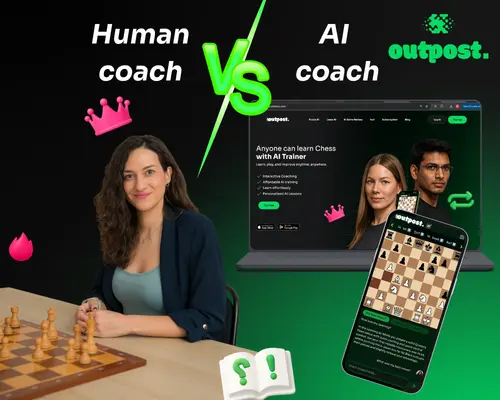
AI Chess Coach vs Real Chess Coach: When to Use Which (And Why You Need Both)
The AI isn't taking the coach's job. It's bringing more players to the coach.
A chess coach recently commented on one of our posts: "If this is real it's going to take away my chess coaching job." Half joking. Half not. We understand the concern. Every chess coach we know has heard some version of "why would I pay you when ChatGPT is free?" over the last two years.
Here's what we actually think and why we're building Outpost with both AI Coaches and real human coaches on the same platform, on purpose.
AI won't kill chess coaching. It'll grow the market for it.
The framing is wrong from the start. AI Coaches and human coaches don't do the same job. They occupy different lanes. Both are useful. Neither replaces the other. And used together, they're a much better path to improvement than either one alone.
Let's break down what each actually does, where they beat each other, and how to use them without wasting money.
What an AI chess coach actually does
An AI chess coach analyzes your finished games and explains, in plain language, what happened. Not just "you dropped a piece on move 28" like Stockfish does. The why. What plan you were on. Where your opponent's threat came from. Which move you should have played instead and what pattern you missed. Then, critically, it lets you keep talking. You can ask follow-up questions. "Why not Nf3 instead?" "What if my opponent had played e5 there?".
It's available at 2am, on your phone, on the bus, during a coffee break. It never gets tired. It doesn't judge how basic your question is. It has infinite patience to rephrase the same explanation five different ways until it clicks.
If you've been wondering, can an AI chess coach really explain moves the way a human does? - yes, and for pure logic explanation, somtimes more clearly, because it's not constrained by time or ego. You'll never hear "we covered that last week" from an AI Coach. If you missed it, it'll explain it again. And again.
That's what the Outpost AI Coach is built to do. You finish a game, hit "Review", and start chatting. The coach walks you through the game, and you can drill into any position, any move, any concept from that game. Interactive. Conversational. No booking, no waiting.
Where AI Coaches fall short: they can't watch you across a full tournament weekend. They can't hear the frustration in your voice when you say you're stuck at 1500. They can't build a 6-month training plan for your next OTB event. They don't know that you tilt after 3 losses and need to be told to close the laptop. Those things require a human.
What a real chess coach actually does
A human chess coach reads you, not just your games. They notice when your opening choices don't fit your temperament. They know when to push you into calculation drills and when you need a break. They watch you play, see your body language when time trouble hits, and calibrate the next lesson around what they observed.
A coach is a strategist for your improvement, not just an analyzer of individual games. They build multi-month plans, adjust them when your schedule changes, and hold you accountable when you say "I'll do puzzles daily" and don't.
If you've asked, what can a chess coach do that an AI can't? — the honest answer is three things.
- Emotional calibration (knowing when to push, when to back off).
- Long-term planning (a curriculum built around your specific goals, timeframe, and life).
- Real accountability (a person waiting for you Tuesday at 6pm, who notices when you don't show up).
There's also the mentor dimension. A coach becomes someone who's invested in your chess journey. They celebrate your first tournament win with you. They tell you the truth when you're not putting in the work. That's a relationship, not a service.
You might ask, is a human chess coach worth the money? Depends on your goal. If you want to enjoy chess, understand your losses, and steadily improve to ~1600–1700, an AI Coach covers most of that for a few euros a month. If your goal is a specific rating milestone within a defined timeframe, OTB tournament prep, or a title norm, you'll almost certainly hit a ceiling without a human coach. The last 200 rating points are always about your patterns, and that requires someone who knows you.
The honest side-by-side
Here's the comparison, without marketing spin:
| AI Chess Coach | Real Chess Coach | |
|---|---|---|
| Availability | 24/7, instant | Scheduled sessions |
| Cost | ~€4/month (or free tiers) | €30–€150/hour |
| Post-game analysis | Excellent | Excellent (slower) |
| Interactive follow-up questions | Unlimited, no judgment | Yes, but bound by session time |
| Long-term training plan | Limited | Their core value |
| Emotional calibration | None | Their superpower |
| Accountability | None (you have to self-drive) | Their superpower |
| Opening prep for specific opponent | Limited | Excellent |
| Tournament weekend support | None | Direct support |
| Ceiling | Great to ~1600–1700 | No ceiling |
| Best for | Daily practice, game review, tactics | Structured improvement, competitive goals |
Read the table honestly. Neither wins across the board. They win on different rows. Which is exactly the point.
The winning move: use both
Here's the pattern we see in the players who actually climb ratings on Outpost:
- Use the AI Coach daily. Review every serious game. Ask it dumb questions. Build the habit of understanding why you played a move. That's 5 minutes a day, and it moves your rating.
- Add a human coach when you plateau. Rating stuck at 1700 for 6 months? Time to bring in a human. They'll spot the pattern you can't, because you're inside it.
- Use AI between coaching sessions. Your coach gives you homework. AI helps you actually do it. Fewer awkward "did you review the games?" moments in your next session.
Will AI kill the chess coaching industry? History says the opposite. Every technology wave in chess: printed opening books, engines, YouTube analysis, streaming chess, has grown the coaching market, not shrunk it. More visibility to chess = more players entering = more players eventually wanting a coach when they hit their ceiling.
AI is the biggest gateway to chess in decades. It removes the "I don't know enough to start" barrier. It converts curious scrollers into daily players. Some of those daily players will want a real coach eventually. That's not competition for coaches. That's their pipeline.
How to actually find both on Outpost
We built Outpost to hold both sides of this. Not because it makes a nice marketing slide, but because that's how improvement actually works.
The AI Coach lives inside Game Review. Finish a game, hit review, and start the conversation. Ask anything about any position from the game. Not just what the evaluation says, what to do about it, why it happened, and what to practice next.
👉 Try the Outpost AI Coach on your last game.
Real human coaches live in the Outposters directory. Head to the Search tab in the app, open the Outposters list, and filter by role (Trainer), rating range, spoken language, or country. Every trainer profile lets you message them directly through the app. No third-party booking site. No email chain that dies in someone's spam folder. Direct contact, coach-to-student.
If you've asked, how do I find a chess coach online? that's how, and it takes about 90 seconds inside Outpost. You'll see the coach's title, rating, price range (if they list it), languages they teach in, and the countries they've worked in. Pick two or three, message them, see who responds and clicks with you.
Coaches who want to be discoverable on Outpost: same route, set your profile role to Trainer, fill out your rating, languages, and pricing, and you'll show up in student searches. It's free, and we're building this side of the platform actively with the coach community, not against it.
To every chess coach reading this
Your job isn't going anywhere. But it is changing, and how you position yourself over the next 12 months matters.
The coaches who thrive won't be the ones fighting AI. They'll be the ones who use it as an on-ramp for their next generation of students. Recommend the AI Coach for daily reviews between your sessions. Let it handle the "explain this move" grind, so your paid hours are spent on the things AI can't do: building the plan, reading the student, holding them to it, mentoring them through their first tournament.
Chess is bigger than it's been in 30 years. AI didn't cause that alone, but it's a real part of the wave. The players AI brings in will eventually want a human. That's you.
We're building Outpost as the meeting point: AI Coach for the daily grind, human coaches for the human parts. If you're a coach and you want to be part of that, we'd love to have you on the platform.
📩 Coach onboarding: info@outpostchess.com
Try both, today
Start with the AI Coach on your last game. Then browse the Outposters directory and pick a coach whose style fits yours. That's the winning move.
👉 Try the AI Coach on your last game, free tier gives you 5 review messages per day.
👉 Find a real chess coach on Outpost → Search tab → Outposters list → filter → message directly.
Use both. Improve faster than either alone.
Team Outpost
👉 Download Outpost Chess Mobile App for FREE on:
App Store: https://apps.apple.com/ng/app/outpost-chess/id6502770097
Google Play: https://play.google.com/store/apps/details?id=com.outpostchess


