

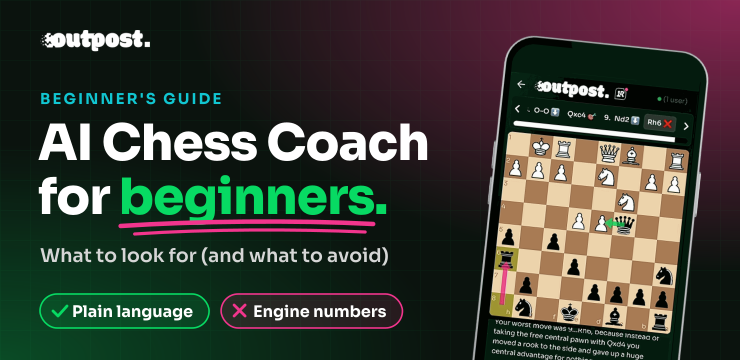
AI chess coach for beginners: what to look for (and what to avoid)
For a beginner (roughly 0 to 1200 rating), the right AI chess coach does four things: explains moves in plain language, handles dumb questions patiently, teaches you one real opening to rely on, and gives you targeted puzzles. Skip anything that wraps a chess engine in a chat window or that drowns you in theory. Here's what to look for and the free starting point on Outpost.
What "beginner" means here
For this post, beginner = 600 to 1200 rated online. You know how the pieces move. You've lost a lot of games. You're not sure why most of them. You want to actually improve, not grind.
If you're below 600, you don't need an AI coach yet. You need to stop hanging pieces on move 10, which happens by playing more games and learning the rules of what pieces defend what. An AI coach is overkill at that level. It becomes useful once you start finishing games without losing your queen in the first 15 moves.
Full definition of what an AI coach actually is, if you want it: What is an AI chess coach.
The 4 features that actually matter for a beginner
1. Plain-language explanations
A beginner needs "you dropped your knight because you didn't check what the bishop attacked" — not "-2.3 after Bxf3." Engine numbers are useless to you at this stage. You need words.
Any AI coach that gives you engine notation without translation is a tool, not a coach.
2. Patience with dumb questions
You will ask what "developing pieces" means. You will ask why kings castle. You will ask why your queen can't stay in the middle. A good AI coach answers patiently every time. Humans sometimes don't.
If you can't ask basic questions without feeling judged, you're using the wrong coach.
3. One real opening to rely on
Beginners don't need 30 openings. They need one for White, one for Black. The right choice at this level is low-theory, principled, and forgiving when you forget a move.
For 600-1200, we recommend:
- White: The London System. One setup. Plays against almost anything. Impossible to lose quickly.
- Black: The Caro-Kann Defense. Solid, hard to crush, teaches good piece placement.
Both are available free in Outpost's Openings module.
4. Targeted puzzles (not random ones)
Random tactics puzzles are fine. Puzzles that specifically target the tactics you keep missing are better. A good AI coach generates puzzles based on your games, so you're drilling exactly what's weak.
If the puzzle feature is generic ("here's 10 random mate-in-2s"), you'll get slow improvement. If it's tied to your actual weaknesses, you'll get fast improvement.
What to avoid as a beginner
Avoid: AI coaches that assume you know notation. If the coach says "after 15. Bxh7+ Kxh7 16. Ng5+" without a board next to it, you're already lost. Look for tools that show you the position and explain in words.
Avoid: heavy opening theory tools. You don't need 20 moves of Sicilian Najdorf. You need 6 moves of something simple you understand. Any tool pushing deep theory on a beginner is wasting your time.
Avoid: generic chatbots pretending to be chess coaches. The summary: general AI occasionally invents chess content. Beginners can't tell the difference between invented and real. That's dangerous.
What realistic improvement looks like
A 900-rated beginner who follows the loop (one game review a day + 5 puzzles + 20 minutes a week on one opening) can expect:
- Week 1: Rating stays roughly flat or wobbles. You're mostly diagnosing your own weakness. This is the hardest month because you don't see numbers moving.
- Month 1: Rating starts climbing. You spot your own blunder patterns before they happen. 100-200 points gained is realistic.
- Month 3: You're near or past 1200. Your opening is automatic. The coach is pointing at move 20 patterns, not move 8 blunders.
That's the normal pace. Some beginners move faster. Some slower. The variable is reviews, not talent.
Full 90-day plan here: How to improve your chess rating from 1000 to 1400 with an AI chess coach.
The daily loop (10 to 15 minutes)
- Play 1 short game. 5+0 blitz is fine.
- Open the game review. AI walks the game, flags the moment it turned.
- Ask one question. "What was the pattern I missed." Follow up once. Keep asking until it clicks.
- Do 5 puzzles. Targeted to the pattern you just reviewed.
Repeat 5 days a week. That's the entire plan for the first 2 months.
Common question: should I get a human coach instead?
Not yet. At the 600-1200 beginner range, a human coach is overkill. Your mistakes are so pattern-based that an AI coach fixes them faster and for less money. Human coaches become useful around 1400+, when the mistakes get subtler and the patterns get sharper.
Full comparison: AI chess coach vs real chess coach.
If you're a parent looking for a coach for a child who's just starting: AI coach first for the first 300-400 rating points, then consider a human coach for longer-term development. The AI covers the daily "why did I lose this game" work that a human coach shouldn't be charging for anyway.
Start free
- Full product: Outpost's AI chess coach page
- Free plan: 1 game review, 5 questions, 5 puzzles daily, London and Caro-Kann openings, your first lesson
- Go Pro when you're past 1200 and want more: 10 EUR a month
Download the Outpost Chess app.
- iOS: App Store
- Android: Google Play
A good AI chess coach for a beginner is patient, plain, and focused. Pick one that does the four things above. Skip the rest.
Team Outpost


