

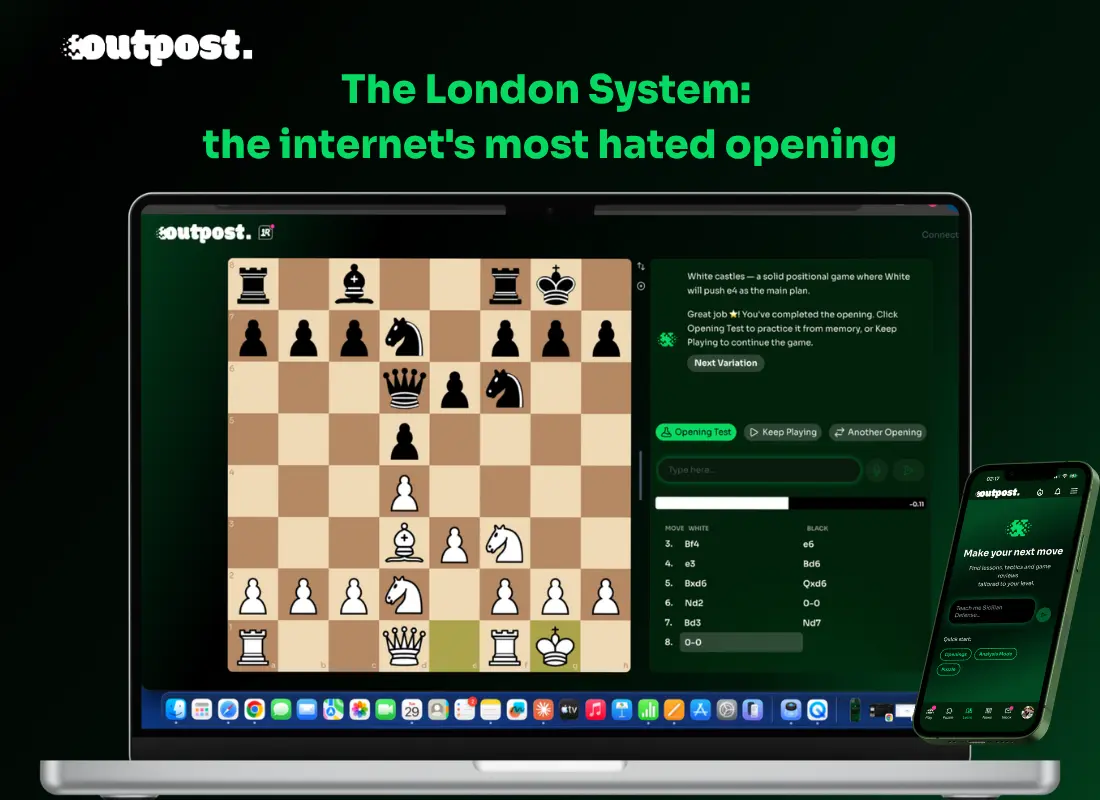
The London System: the internet's most hated opening (and exactly why you should play it)
The London System is a simple d4 opening with a fixed setup: d4, Nf3, Bf4, e3, Bd3, c3, Nbd2, O-O. It plays the same way against almost any Black defense. Purist chess creators hate it because it's boring. Amateur ratings climb with it because it works. If you're between 600 and 1400 and you want an opening you can rely on with 1 hour of study instead of 40, this is the one. Free to learn on Outpost, deeper lines and Outposty AI coach in Pro.
Why does the internet hate the London System?
Because it works, and it doesn't require you to be clever.
The London is a system opening. You play the same 6 or 7 moves regardless of what Black does. There's no explosive theory battle, no forcing preparation, no memorizing the 14th move of a 2019 top-level game. You develop your pieces to their happy squares and start playing chess.
Chess purists find that offensive. They call it uncreative, dry, an insult to the artistic tradition of the opening phase. Their real complaint is that a 1400 who plays the London beats a 1400 who plays "correct" openings badly. That upsets them. It shouldn't upset you.
Fun fact for anyone who has been told the London is "for beginners:" Magnus Carlsen played it in a World Championship match against Fabiano Caruana. So did Kramnik. Adams. Anand's team studied it seriously. The people at the very top do not share the internet's opinion.
The moves. Here's what you actually play.
The London System setup goes like this, in the standard order:
- d4. Claim the center.
- Nf3. Control e5, prepare kingside development.
- Bf4. The defining move. The bishop comes out before you close it in with e3.
- e3. Supports d4, opens the d1-h5 diagonal for your queen.
- Bd3. Bishop pair aimed at Black's kingside.
- c3. Solidifies d4, makes your center a triangle.
- Nbd2. Completes development, supports a later Ne5.
- O-O. King safety.
Some players prefer h3 early to stop ...Bg4 pinning your knight. Some go for Nc3 instead of Nbd2 when the position calls for it. The core is still these 8 moves in this order. Learn them and you have an opening you can play against 90% of Black's defenses.
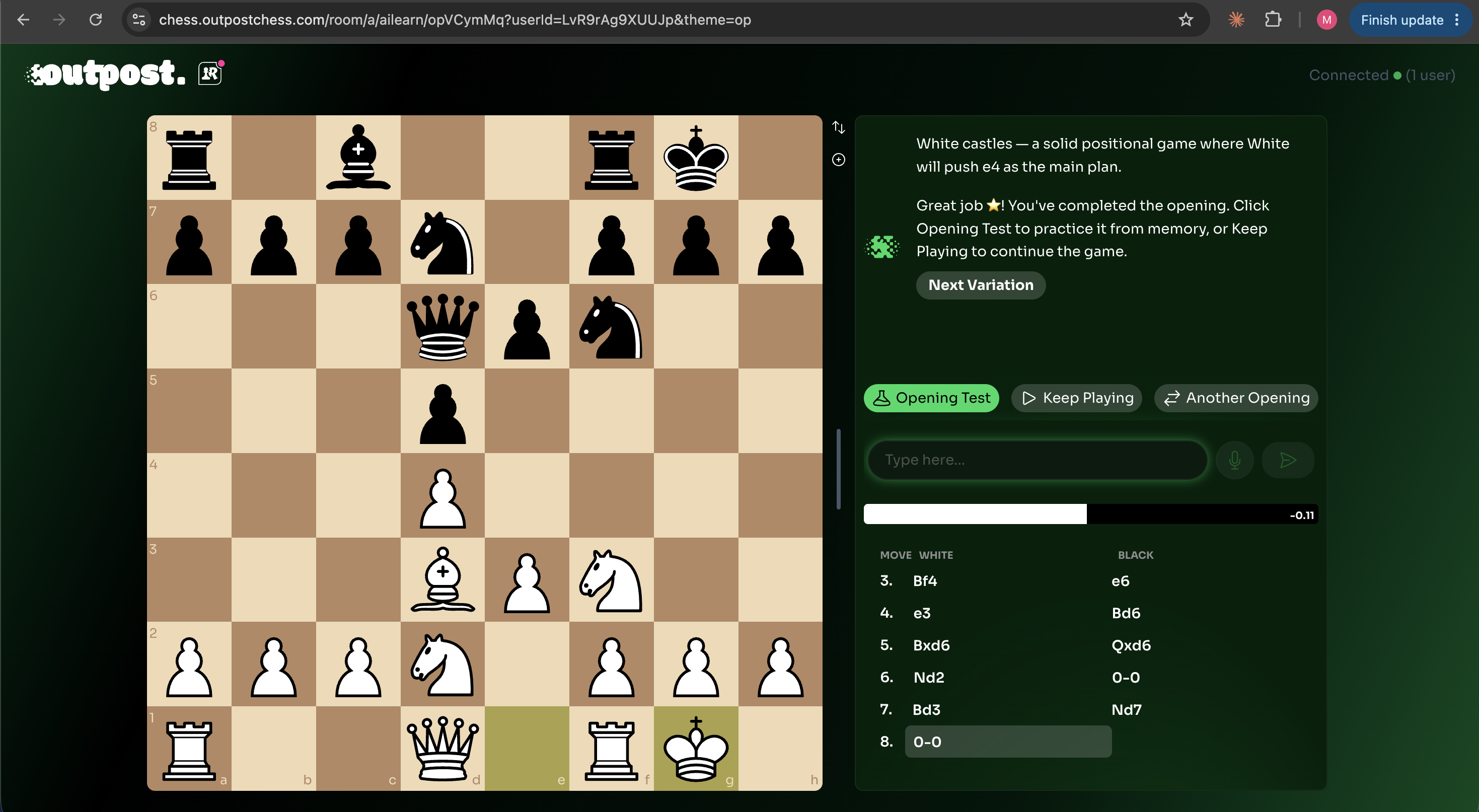
What each piece is doing
- Bishop on f4: eyes the b8-h2 diagonal, controls e5, punishes Black if they weaken the queenside.
- Bishop on d3: aimed at h7. In many lines, this is the piece that delivers the attack.
- Knight on f3, heading to e5: the central outpost is the London's dream square.
- Knight on d2: flexible, can reroute to f3, c4, or e4 depending on the game.
- Pawn triangle c3-d4-e3: nearly impossible to attack. You will not lose the center.
- Queen: stays on d1 for now, often swings to c2 or e2 later.
The whole point of the setup: your pieces coordinate. You don't need to memorize what to do. Your position tells you.
The three plans, in order of importance
Plan 1: kingside attack. Push Ne5, then f4 to support it, then bring the queen to h5 or f3. Half your games as White will end this way. Black castled short, and their king is where your bishop on d3 was already looking.
Plan 2: minority attack on the queenside. If Black plays a symmetric setup and there's no kingside break, push b4-b5 to create weaknesses in Black's queenside pawns.
Plan 3: central break with e4. When Black is passive, prepare e4 to open the center. Less common than the kingside attack, always available when the position invites it.
Every London game is one of these three plans. Notice how much simpler that is than trying to remember what to do in the Ruy Lopez, Berlin defense, exchange variation, move 22.
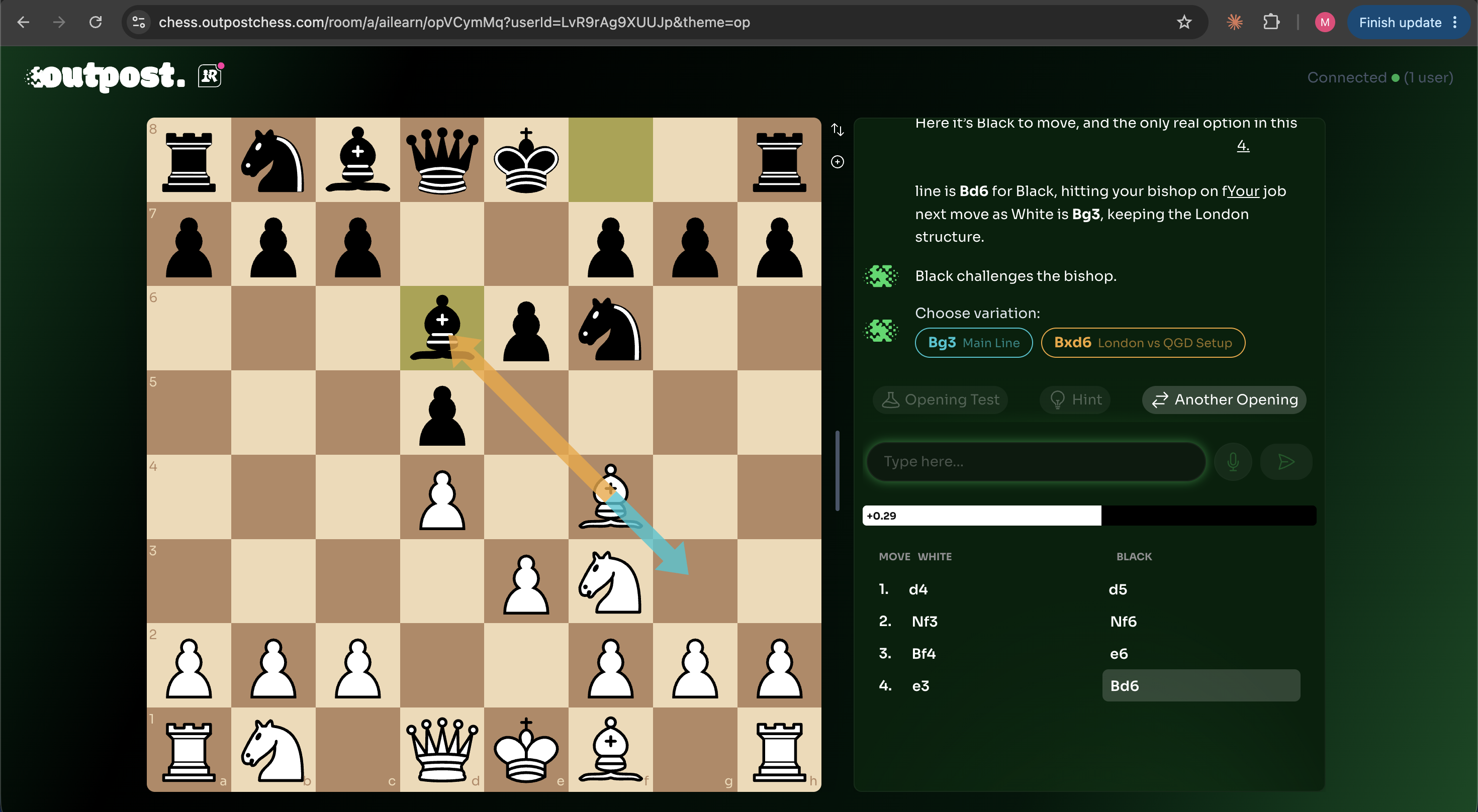
What Black actually does against the London
Three most common responses at the 600-1400 level:
1. ...d5 with a symmetric setup. Black mirrors you. This is fine. You still develop, still aim at h7, and Black usually does not know their own plan. Advantage: you.
2. ...c5 hitting your center. Play c3 to support d4, and if they take, recapture and develop normally. You are not in trouble.
3. King's Indian style with ...g6. Slightly annoying. The Bf4 is still well placed. Develop and look for e5 later.
You will almost never face something you cannot handle with a piece setup. That is the entire pitch.
Why the London wins games for 600-1400 players
Openings for improving players need three things:
- Low theory burden. You do not have 6 hours a week to study opening theory. The London takes 60 minutes to learn the core and 3 to 5 games to feel comfortable.
- Consistent plans. You should know what you are doing on move 12. The London gives you 1 of 3 plans every single game.
- Solid positions. You should not lose your queen on move 8 to a trick. The London's structure makes that basically impossible.
The London checks all three. That is why it works. Not because it is the strongest opening in chess. Because it is the strongest opening that a busy human can actually learn and execute.
How to learn the London on Outpost
The London System is available free on Outpost's Openings module. You get:
- The main lines explained move by move, not dumped as a PGN
- The plans behind each setup, in plain English
- A final test to check you actually learned it
- Outposty, Outpost's AI chess coach, ready to answer questions like "what if my opponent plays this weird move" or "why not e4 first"
Outposty is the part most opening tools do not have. You can study a video for an hour and still not know what to do when your opponent plays something the video did not cover. With Outposty you ask, and get a plain-language answer from any position, on any move, any time.
Once you have the London working, Pro opens up the full openings library. Sicilian, King's Indian, French, Nimzo, dozens more. Learn one at a time, at your own pace, with Outposty in your corner.
Bottom line
The London System is hated by chess purists and loved by rating gainers. If you are rated 600 to 1400 and you want one opening you can rely on with less than an hour of study, this is it.
You do not need to be clever with your opening. You need to know what you are doing when your opponent stops cooperating. The London handles both.
Start playing the London today
- Learn it free on Outpost: outpostchess.com, open the Openings module
- Ask Outposty anything: AI Game Review
- Go Pro for the full openings library and unlimited Outposty: 10 EUR a month
Download the Outpost Chess app.
- iOS: App Store
- Android: Google Play
Learn the setup. Play the setup. Win with the setup. Repeat.
Team Outpost
Also read: Why Are Chess Openings Important and How Lerning Openings works on Outpost with the AI coach, Outposty.


