

Why Are Chess Openings Important? (A Guide for 600–1400 Rated Players)
Openings won't win you the game. They'll decide if you have a game to win.
If you've ever asked "how important are chess openings, really?" - you've probably heard two opposite answers.
Coach A says: "Openings don't matter for beginners. Just develop your pieces and don't blunder."
Coach B says: "You need to memorize 15 moves of theory or you'll get crushed."
Both are wrong. Or rather, both are partially right, and neither one tells the actual story.
Here's the honest truth about why chess openings matter, especially for players in the 600–1400 rating range, and how to learn them without wasting your life memorizing PGN files.
What openings actually do for you
Chess is one game divided into three phases: opening, middlegame, endgame. The opening is the first 10–15 moves. And here's what it decides:
- Where your pieces go. A good opening develops your knights, bishops, and rooks to squares where they can do things. A bad opening leaves them on the back rank, blocked, or attacking nothing.
- How safe your king is. Good openings castle early and don't leave your king exposed. Bad openings ignore king safety until it's too late.
- Which part of the board you control. Controlling the center (d4, d5, e4, e5) means your pieces reach more squares. Losing the center means your pieces are cramped.
- What your plan is. Every good opening has a plan , where to attack, what to trade, what pawn breaks to aim for. If you don't have a plan in the middlegame, you didn't play a real opening.
Openings don't win the game. They set up whether you have a game to play at all.
That's the honest answer to "why are chess openings important."
The beginner myth: "openings don't matter"
You'll hear this a lot: "just play good moves, openings don't matter for beginners."
That's partially true. If you're 600 rated, you're not going to lose to a Caro-Kann Advance variation, you're going to lose because you dropped your queen on move 12.
But once you're past 800, openings start to matter, a lot. Here's why:
- You're facing opponents who have a plan. If you don't, you're already behind.
- You're getting to the middlegame with worse piece placement and worse king safety.
- You're wasting your first 10 moves figuring out what to do while your opponent is executing.
By the time you hit 1200–1400, "just develop your pieces" is no longer enough. You need to know at least one solid opening for White and one for Black, and understand the plans behind them.
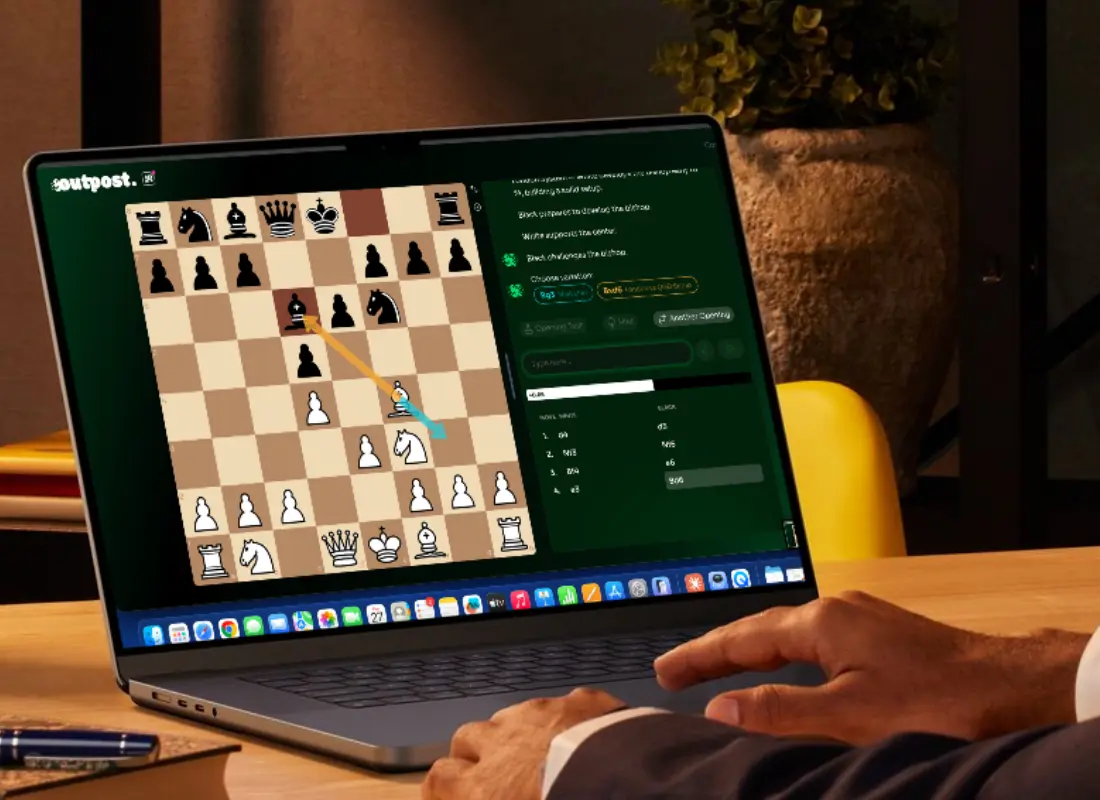
This is exactly the range where Outpost's new Openings module is built for. You can start learning the Caro-Kann or London System for free on Outpost, both are solid, principled openings that carry you all the way to 1600+ without needing constant updates.
The intermediate mistake: memorizing lines
The opposite mistake is worse. You watch a video, you memorize 12 moves of the Sicilian, you feel prepared. Then:
- Your opponent plays move 4 differently than the video
- You have no idea what the plan is
- You play a "book" move that's technically correct but you don't know why
- Three moves later you're in a position you've never seen and you have no idea what to do
Memorizing moves is not learning openings. Learning openings means understanding:
- What each move does (attacks, defends, develops, controls)
- What your opponent's realistic responses are
- What the plan is if they play the main line
- What the plan is if they deviate
That last one is where most opening study collapses. And it's exactly where an AI coach changes everything.
How to actually learn openings (the AI coach way)
Here's the loop that actually works:
- Pick one solid opening for White and one for Black. (For 600–1400: London System for White, Caro-Kann for Black. Both available free on Outpost.)
- Learn the main line 6–10 moves deep. Not memorized - understood. Know why each move is played.
- Ask questions when you don't understand. This is where most improvement happens. What does move 6 do? Why not this square instead? What if my opponent plays this weird move?
- Play the opening in 5–10 games. Real games, real opponents.
- Review the games with an AI coach. Where did you deviate? Why? What should you have done?
- Repeat.
Steps 3 and 5 are what used to require paying a human coach €30–€100 an hour. Now Outposty, Outpost's AI Coach, does exactly that on your phone, unlimited, for €10/month on the Pro plan. That's the shift.
You can try Outposty free right now — you get limited daily access, enough to see how it works. If it clicks, Pro unlocks unlimited coach questions.
Which openings should a 600–1400 player learn?
Short list, opinionated, this is what we recommend to players in your rating range:
For White:
- London System: one setup, plays against almost anything, low theory burden, solid positions. Perfect for building an opening habit without drowning in variations.
For Black (against 1.e4):
- Caro-Kann Defense: solid, positional, hard to crush. Teaches you good pawn structure, good piece placement, and how to fight for a draw when you're worse (which is a skill in itself).
For Black (against 1.d4):
- Learn one of the solid setups later. For now, focus on getting Caro-Kann and London working.
That's two openings to learn. Not thirty. Two.
Both are available in the free tier on Outpost, including basic lines and a final test to check what you learned. Pro gets you dozens more when you're ready to expand.
What NOT to do
- ❌ Learn a new opening every day
- ❌ Memorize 20 moves of the Sicilian Najdorf
- ❌ Copy whatever your favorite grandmaster played last week
- ❌ Play "hope chess" and improvise from move 1
- ❌ Watch a 60-minute opening lecture and expect it to stick
Instead:
- ✅ Pick two openings and stick with them for 2+ months
- ✅ Understand the plans, not just the moves
- ✅ Ask questions every time something feels unclear
- ✅ Review your games and see where you deviated
The last one is where Outposty earns its keep. Paste your last 3 games into AI Game Review on Outpost and ask "where did I stop following my opening plan?" You'll get a plain-language answer in seconds.
The bottom line
Are chess openings important? Yes, for anyone past 800 rating, absolutely. They decide whether you get to the middlegame with a plan or with a mess.
Do you need to memorize hundreds of moves? No. You need to understand two openings deeply.
Can you learn them yourself? Yes, especially now that AI coaches make it possible to ask questions the way you would with a human coach, without the €50/hour price tag.
Start today
Outpost's Openings module is live. In the free tier:
- Caro-Kann Defense (for Black against 1.e4)
- London System (for White)
- Basic lines explained clearly
- Final test to check what you learned
- Outposty, your AI chess coach, available with limited daily questions
Ready to go deeper? Pro unlocks the full opening library + unlimited Outposty for €10/month.
📱 Download the Outpost Chess app:
- iOS: App Store
- Android: Google Play
Or start on the web at outpostchess.com.
Your first real opening is a few moves away.
GGs, Team Outpost


