

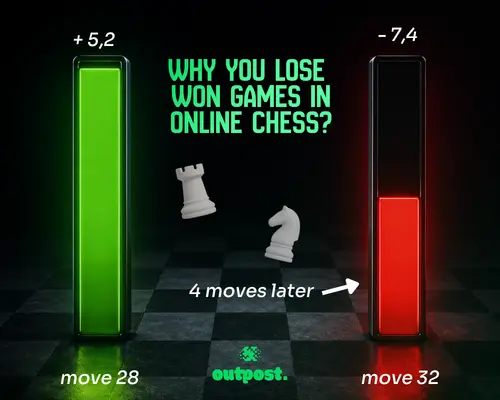
Why You Lose Won Games in Online Chess (And the 5-Step Fix)
You were +5. Then you weren't. Welcome to the most painful pattern in online chess.
You're up a piece. The eval bar is solid green. You feel that small dopamine hit of "I've got this one." Two minutes later you're staring at the resign button wondering what just happened.
If this is happening to you regularly, you're not a bad chess player. You're a player whose brain isn't built for the specific weirdness of converting an online game which is a different skill from attacking one.
This post is about that skill. Specifically, the 5 patterns that cause online amateurs (1000–1700, where it hurts most) to flip from winning to losing — and the protocol that fixes each one.
The "Winning Brain Trap" - what's actually happening
When you're attacking, your brain is wired to look for threats and combinations. Aggressive mode. You scan, you calculate, you commit.
The moment the eval flips your way and stays there for a few moves, something changes. You shift from finding moves to protecting a lead. Your calculation depth drops. You stop checking opponent threats. You play "safe" moves that are actually slow moves.
Meanwhile your opponent has nothing to lose. Their brain is fully engaged because they're behind. They're calculating threats you've stopped looking for.
You're not blundering because you played a bad move. You're blundering because you stopped thinking before you played it.
Add the dynamics of online play: clocks, premoves, phone notifications, late-night tilt, and you have the recipe for "I was +5 and lost."
Let's fix each piece.
Step 1: Break the "Evaluation Freeze"
The single biggest pattern in online chess: you see a +3 / +5 / +M5 evaluation in your head and your brain treats the game as over. From that moment, you're playing for "don't blunder" instead of "what's the best move?"
The fix. After every move where you're winning, ask one specific question before you touch a piece:
"What's the most annoying move my opponent could play right now?"
Not "is my position winning?" (you already know). Not "what's my plan?" (you already have one). Just: "what's the worst thing they can do to me on this move?"
This forces you back into threat-detection mode, the same mode that got you the winning position in the first place.
If you only do one thing from this post, do this.
Step 2: Trade Pieces. Not Pawns.
When you're up material, the technically correct conversion strategy is brutally simple: trade pieces, keep pawns.
- Up a piece? Trade queens.
- Up an exchange? Trade minor pieces.
- Up a pawn in the endgame? Trade everything that isn't a pawn.
In online play, most amateurs do the opposite. They push their extra pawn early because it feels active. They avoid trades because trades feel boring and they want to win with a checkmate. Then they get mated on the back rank in the resulting middlegame.
If you remember nothing else: the boring endgame is the winning endgame.
Step 3: The 10-Second Protocol for Time Scrambles
Online chess is full of moments where you're up material AND down to single-digit seconds. This is the #1 conversion killer in blitz and bullet.
The instinct is to premove and pray. Sometimes it works. Often it loses you the game in one click.
The protocol when you have ≤10 seconds and a winning position:
- Stop calculating. You don't have time. Stop trying.
- Make the most defensive legal move you can find. King to a safe square. Trade a piece. Block a file.
- Do NOT premove a capture. Premoved captures are the #1 way to walk into a recapture-and-tactics trick.
- If the position is calm -> just shuffle. Move your king or rook back and forth. Let your opponent burn their clock.
You don't need to find the best move. You need to not blunder for 10 seconds. There's a difference.
Step 4: Skip the Brilliancy. Play the Boring Move.
Online chess teaches you a bad habit: when you're winning, you start looking for the prettiest finish. The sacrifice. The mate-in-3. The move that would make a YouTube thumbnail.
This is your attacking brain re-engaging in a position that no longer needs it. And it's where you lose the game.
The rule. If you have a clearly winning move (trade queens, capture a piece, simplify), play it. Even if there's a "more impressive" move you think you see. The boring move wins the game. The brilliancy loses about a third of the time, and you don't get the YouTube thumbnail anyway.
You don't need to win with style. You need to win.
Step 5: The Tilt Clock. Know When to Stop.
Here's the math nobody talks about: after three games in a row, your blunder rate roughly doubles. After five, it triples. After eight games of bullet, your decision-making is statistically worse than a player rated 200 points below you.
This is why amateurs who play "just one more game" finish the night having dropped 60 rating points from their daily peak. Tilt isn't just emotional, it's biological. Your brain is tired.
The protocol.
- After 2 losses in a row → stop for 10 minutes. Walk away. Drink water.
- After 3 losses in a row → stop for the day. Tomorrow exists.
- After a big winning streak → also stop. You're about to lose 4 of the next 5 chasing the high.
Closing the app at the right time is a chess skill. It's just one nobody teaches.
How to Spot YOUR Specific Pattern
Every player has a signature version of this. Some flip in time trouble. Some flip on move 25. Some flip after 4 games of bullet. Some always blunder in the same kind of position (minor piece endgames, queen trades, the moment a rook lift completes).
The fastest way to find yours: review your last 3 losses where you were winning.
Not all your losses. Specifically the games where the eval bar was green for you at some point and ended red.
For each one, ask:
- What was the move where the eval flipped?
- What had I missed (a threat, a tactic, a clock issue)?
- What were the three moves I played right before the flip?
That third question is where your pattern lives.
This is exactly the kind of analysis the Outpost AI Coach is built for. Paste the game, ask "where did I switch from winning to losing, and why?" and follow up with "what should I have done instead?" The coach walks you through your specific tilt point in plain language, not just an eval bar dropping.
→ Try the AI Coach on your last won-then-lost game
FAQ
Why do I always blunder when I'm winning in online chess? Your brain switches from "finding moves" mode to "protecting a lead" mode. Your calculation depth drops, you stop checking opponent threats, and you play slow safe moves while your opponent (who has nothing to lose) is fully engaged. The fix is to keep asking "what's their most annoying response?" before every move.
Is it OK to premove when I'm winning? Yes, but only premove defensive, simplifying moves. Never premove a capture. Premoved captures are the #1 way to walk into a recapture-and-tactics trick that flips the game.
Should I offer a draw when I'm winning? No. If you're winning, play to win. If your opponent offers a draw and you're up material with time, decline and trade pieces. Offering a draw from a winning position is your tilt brain trying to protect a number.
What's the best time control to avoid losing winning games? Rapid (10+0 or 15+10). Blitz and bullet amplify every conversion error because you don't have time to think when the time crunch hits. If you keep losing winning games, switch to Rapid for a week and watch how your rating responds.
Does playing on mobile cause more blunders than playing on desktop? Mouseslips and mistouches do happen more on touchscreens, but the bigger factor is context. People play mobile during distractions, phone notifications, transit, conversations. The fix isn't switching devices. It's protecting your attention for the 5–10 minutes you're playing.
How many games in a row is too many? Three. After three games in a row your blunder rate roughly doubles. After five, it triples. Build the habit of stopping at three, especially after a winning streak, that's when most players give back everything they gained.
Will reviewing my losses actually help? Yes, but only if you review the pattern, not the individual move. Most players review one game, see "I dropped a piece on move 28," and move on. You want the recurring trigger: time pressure? Specific piece type? After a winning streak? An AI Coach is much faster at spotting your pattern across multiple games than you are.
What's the difference between an engine analysis and an AI coach? An engine tells you the best move. An AI coach tells you why it's the best move, what your move missed, and answers your follow-up questions in plain language. For converting won positions, the why matters more than the move itself, because the move you "should have played" is usually obvious in hindsight. The pattern that made you miss it isn't.
Last Word
Winning online chess positions don't lose themselves. You're losing them, and you're losing them in the exact same way, game after game. The good news: once you know your pattern, fixing it doesn't take talent. It takes a protocol.
Your homework: open your last 3 losses where you were ahead. Find the move where it flipped. Ask why. Don't guess, use the AI Coach if you can't see it on your own.
The conversion skill isn't optional. It's the difference between "good attacker stuck at 1500" and "complete player at 1800."
Stop losing the game you already won.
Team Outpost


