

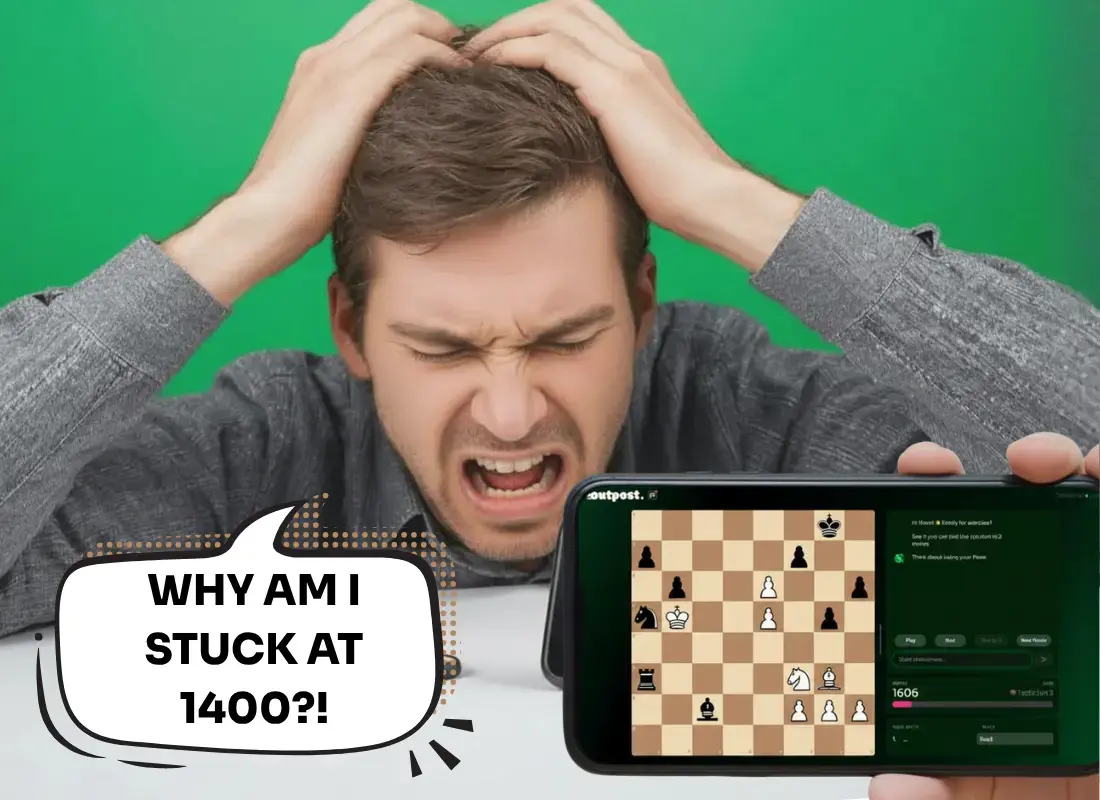
You played the same opening you've played a hundred times. You saw the position. You felt good. Then ten moves later your queen was hanging and the engine flashed a cold red ?? next to your move.
Click "next." Forget. Lose again tomorrow.
If that loop sounds familiar, you're not alone and it's not because you're untalented. Most amateurs hit a wall around 1000, 1400, or 1800 Elo and stop improving for months. Some quit. The ones who break through almost always change one thing: they stop reviewing their games for what went wrong and start understanding why.
This is what an AI chess coach does that engines and even Chess.com Game Review can't. Let's break it down.
The real reason you're stuck (and it's not "study more openings")
When players ask me why they're stuck at 1400 Elo, they almost always blame openings. "I need a better repertoire." "I'm getting outprepped."
They're wrong about 90% of the time.
The actual culprit at every plateau is the same: a pattern recognition gap. Your brain has internalized the patterns that get you to your current rating, and nothing more. The next 200 points require a completely different layer, quiet positional moves, prophylaxis, endgame technique, knowing when not to capture and you can't internalize patterns you can't articulate.
Here's the test. After your last loss, can you finish this sentence in plain language?
"I lost because I didn't understand that when my opponent played [move], it threatened [idea] because [reason]."
If you can't, you don't have an opening problem. You have a comprehension problem. And no amount of memorizing lines will fix it.
Why "blunder" feedback alone doesn't fix anything
Open Chess.com Game Review or Lichess analysis on your last game. You'll see something like this:
- Move 18:
??Blunder. Best move wasRxe6. Evaluation: -3.4 - Move 22:
?Mistake. Best move wasNd5. Evaluation: -1.8 Helpful? Sort of. Actionable? Almost never.
Engines tell you the correct move. They don't tell you the principle behind it. They don't know if you're 1100 or 2100. They don't speak your language. They certainly can't answer when you ask, "But why couldn't I just take the knight?"
A 1400 player who saw Rxe6 is best doesn't need to be told it's best. They need to be told why their move loses, in their language, at their level. That's a coaching problem, not an engineering problem and it's exactly the gap an AI chess coach was built for.
What an AI chess coach actually does differently
An AI chess coach isn't an engine with a friendlier UI. It's a fundamentally different tool. The core differences:
Conversational. You can ask follow-up questions. "But why couldn't I just take the knight?" "What if I'd played h3 first?" "Is this the same idea as in the French Defense?" A real coach answers these. So does an AI coach. An engine just shrugs and shows you a number.
Contextual to your level. A good AI coach calibrates explanations to your rating. A 1100 player gets "this trade gives your opponent a passed pawn. Passed pawns are pieces that no enemy pawn can stop, so they often win the game." A 1700 player gets "this is a Karlsbad pawn structure problem: the minority attack is your only winning plan and you just gave it up."
Native language. This matters more than people admit. If English is your second language, every nuance of GM commentary on YouTube is friction. An AI chess coach you can chat with in your native language removes that friction completely.
Available at 11pm after a loss. The single best moment to learn from a chess game is the 60 seconds after it ends. A human coach isn't there. An AI coach is.
A 4-week routine to break your plateau
This routine works for any rating between 800 and 2000. It assumes you have access to an AI Game Review tool ( we built ours into Outpost Chess) but the framework is portable.
Week 1: Diagnose. After every loss, run AI Game Review on the game. Focus on only your first major mistake. Ask the coach: "Why was this a mistake? What was I missing?" Don't move on until you can paraphrase the answer in one sentence.
Week 2: Find your missed wins. Run AI Game Review on your draws and wins. This is the secret weapon. You'll find that even your wins contained 2-3 moves where you missed a faster mate or a clean conversion. The coach surfaces them. Suddenly you're not just patching losses, you're sharpening edges.
Week 3: Convert insights into puzzles. Use AI Puzzles thematically: pin tactics, back-rank patterns, opposite-colored bishop endings, whatever your reviews kept flagging. Pattern recognition is built by repetition with feedback. Both halves matter.
Week 4: Compress the feedback loop. Play one game. Immediately review with the AI coach before you play the next. Three games in a session, three reviews. The faster the loop, the faster the learning.
What to track: Yes, your rating. But more importantly, the vocabulary you're building. Are you starting to use words like prophylaxis, outpost, bad bishop, zugzwang and meaning them? That's the actual proof you're improving. Rating follows.
AI coach vs. engine vs. human coach (a quick decision guide)
For honest comparison, here's how the three options actually stack up for an amateur trying to break a plateau:
Chess engine (Stockfish, etc.): Maximum move accuracy, zero pedagogy. Use for verifying analysis after you've already understood it. Free.
Human coach: Best pedagogy, fully personalized, but €40–100/hour and limited to scheduled sessions. Use for periodic recalibration if budget allows. The bottleneck for most amateurs.
AI chess coach: ~80% of a human coach's pedagogical value at <€5/month, available 24/7, in your language, after every game. Use for the daily reps that actually compound.
The pragmatic answer for most amateurs: AI coach for daily reps, optional human coach quarterly if you're serious. That's a coaching budget under €100/year, less than a single hour with most titled coaches, and it's the routine that can broke students out of long plateaus when coaching in person.
Why we built this into Outpost Chess
Quick context: The founder is Lena Govedarica, Woman International Master, FIDE International Arbiter, and she've been coaching club-level players for over a decade and watched the same plateau pattern, with the same root cause, hundreds of times. So when we built Outpost Chess, the AI Game Review stopped being a feature on a list, it was the entire point.
What you get:
- AI Game Review - interactive, chat-based analysis of every game you play. Not just "blunder, best move was Nf3." A real conversation about why.
- AI Puzzles - adaptive, themed, calibrated to the patterns you keep missing in your own games.
- Play vs. humans or AI bots - full game variety so you can train any time.
- Web + iOS + Android - your coach travels with you. Most of our players are amateurs reviewing games on the train home from work. Free tier: 5 AI Game Review messages and 5 AI Puzzles per day. Enough to break a plateau if you're consistent. Sterter subscription package is only €4/month, less than a coffee, for unlimited everything.
How to start in the next 5 minutes
If you read this far, you've already done the hardest part: admitting that your current review process isn't working. The next part is small.
- Create a free account at outpostchess.com.
- Download the app — iOS or Android or play in the browser.
- Play one game. Win, lose, doesn't matter.
- Open AI Game Review and ask the coach the one question you're most embarrassed not to know the answer to. Five minutes. One question. That's how plateaus actually break.
Frequently asked questions
Why am I stuck at 1400 Elo? Almost always because your pattern recognition has plateaued, not your tactics. At 1400, you've already absorbed the patterns that get most players to that level. The next 200 points require positional understanding, quiet moves, prophylaxis, endgame technique, that engines and basic game review tools don't explain. An AI chess coach that walks you through why a move works (not just that it's best) is the fastest known way to bridge that gap.
Can AI really help me improve at chess? Yes, and the evidence is the rating curves of players using AI coaching tools. The mechanism is simple: improvement at chess is bottlenecked by feedback quality, and AI coaches close the gap between "an engine told me I blundered" and "I now understand the pattern that caused the blunder." That understanding is what transfers to your next game.
Is Chess.com Game Review worth it? Chess.com Game Review is fine for surface-level "what was the best move" feedback. It's limited because the analysis is essentially engine output dressed up, there's no conversation, no follow-up, and the explanations don't adapt to your rating or language. If you're plateauing, you've outgrown what it can teach you.
What's the best AI chess coach in 2026? The best AI chess coach is the one that actually answers your follow-up questions in plain language at your rating level, in your native language, available the moment you finish a game. Outpost Chess was built around this specific use case: interactive AI Game Review designed by a WIM and chess coach. Free to try, €4/month for unlimited.
How long does it take to break a chess rating plateau? With consistent post-game review (4–5 reviewed games per week) and adaptive puzzles on the same themes, most amateurs see 100–200 Elo movement within 8–12 weeks. The variable isn't talent, it's whether the feedback loop is tight and whether the explanations actually land. Both are solvable problems.
Is Outpost Chess a good Chess.com alternative? For the specific problem of improvement coaching, yes. Chess.com is excellent for ratings, tournaments, and social play, keep your account if you use those. But for the part where you actually can learn from your games by asking questions that you want to be answered, Outpost Chess's AI Game Review is built around conversation rather than engine output, which is what amateurs actually need to improve.


