

How to Analyze Your Chess Games: A Step-by-Step Method for Amateurs
If you've ever finished a chess game, opened the analysis, scrolled past the red question marks, and walked away no smarter than before , this guide is for you.
Most amateurs lose at chess for the same reason: they play the games and they "review" the games, but they never actually analyze the games. There's a difference.
Reviewing is passive, you read the engine's verdict and move on. Analyzing is active: you stop, think, and extract a transferable lesson that shows up in your next game.
The first does nothing for your rating. The second is the single highest-leverage habit in chess improvement.
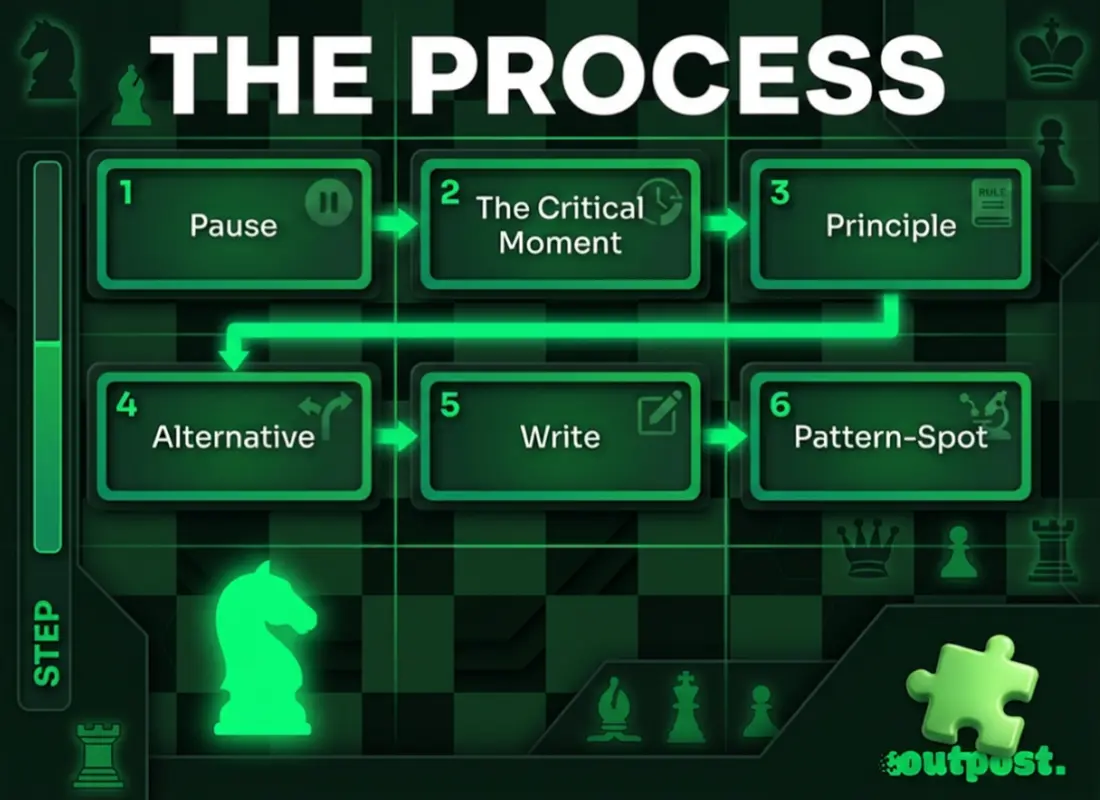
This is the method our coaches teach. Six steps, repeatable, works at any rating from 800 to 2000+ Elo.
Why analyzing your own games matters more than anything else
You can read every chess book on the shelf and watch every grandmaster YouTube video and still plateau, because none of that content is about your mistakes in your positions. Your games are the only training data calibrated to exactly where your understanding breaks.
The math is simple. If you play 5 games a week and analyze 3 of them properly, you extract roughly 15 lessons a month, each one tied to a real pattern you actually misplay. After 6 months that's 90 internalized lessons, every single one of them about your specific gaps. No course can match that level of personalization, because no course knows your games.
The catch: most amateurs skip this work. Not because it's hard, but because nobody ever taught them what "analyzing properly" actually means. Below, the version we teach.
Step 1: Pause before you open the engine
This is the step everyone skips, and it's the one that makes the rest of the method work.
Before you let any analysis tool tell you what was right or wrong, go through the game once on your own. Write down (literally, in a note or on paper) the answers to three questions:
- At what move did I feel my position turn bad? (Trust your instinct here, your gut is often right within 2-3 moves of the actual mistake.)
- Why do I think I lost? (One sentence. "I missed his back-rank threat." "I exchanged the wrong piece." "I didn't have a plan in the middlegame.")
- What's the one thing I would do differently if I replayed this game?
This step takes 90 seconds. It also forces your brain to do the heavy lifting before the engine spoonfeeds you the answer. The reason this matters: in your next live game, you won't have the engine. You'll only have your own judgment. The 90 seconds of self-diagnosis is the rep that trains the judgment.
Step 2: Find your first critical moment, not your worst blunder
When you finally open the analysis, resist the urge to jump to the biggest red mark on the evaluation graph. Scroll back to the first move where the evaluation shifted meaningfully against you, even a swing from +0.4 to -1.2 counts.
The first critical moment is where your understanding broke. The big blunder later is usually just the consequence. If you only fix the blunder, you'll make the same upstream mistake next week and blunder somewhere else. Fix the upstream mistake and the downstream blunders often disappear on their own.
A practical rule: if your game had a clear blunder at move 26, your first critical moment is almost never move 26. It's usually somewhere between moves 12 and 22, where you misjudged a structural decision, picked the wrong plan, or made a casual move that wasn't part of any plan at all.
Step 3: Identify the principle, not the move
This is the most important step in the entire method, and the one that separates real analysis from going through the motions.
When you find the critical moment and see the engine's preferred move, do NOT just note that move and click forward. Instead, ask yourself: what general principle does this move illustrate? Phrase it in plain language that you could explain to a friend who doesn't play chess.
Examples of what a real answer sounds like:
- "The engine wants to trade my bad bishop because my pawn structure was fixed on the same color squares, a piece that has no future should be traded for one that does."
- "The engine wants to play h3 to prevent the knight from coming to g4, when my king is on g1 and my opponent has a queen and a knight, I should prevent the knight from getting close."
- "The engine wants a quiet rook move instead of the capture, when both sides have weak king positions, the first to start trading tends to lose the attacker."
Notice what these have in common: each one is a principle (a transferable rule), not a move (a single instance). You can't carry a move to your next game. You can carry a principle.
If you can't articulate the principle, you haven't actually analyzed yet. You've just looked.
Step 4: Generate one alternative and walk through it
Once you understand the principle behind the engine's move, take 60 seconds to imagine playing the wrong move on purpose and see what happens. Walk through the next 3-4 moves in your head (or on the board) without the engine's help.
The goal isn't to be right. The goal is to feel why the right move is right by sitting with the consequences of the wrong move. Your brain remembers things it has emotionally simulated far better than things it has merely read.
This is also where you spot whether you actually understood Step 3, or whether you just nodded along. If you can't explain why the bad alternative falls apart, the principle didn't land. Go back to Step 3 and try again.
Step 5: Write the lesson in one sentence
Before you close the analysis, write down a single sentence that captures the takeaway. Format: "When [situation], [principle / action]."
Examples:
- "When my opponent has a knight near my king, I should consider h3 or h6 before any other king-safety move."
- "When my pawns are fixed on dark squares, my dark-squared bishop is the piece I should be looking to trade."
- "When both kings are exposed, the first one to initiate trades usually loses the initiative."
Keep a running list of these lessons. After a month, you'll have 20–30 of them, and they'll start clustering, the same 5–6 patterns will appear over and over, which is exactly what you want to discover. Those clusters are your actual weaknesses. Drill them.
Step 6: Pattern-spot across multiple games (the compounding step)
The first five steps make you a better analyst of single games. This sixth step is what makes you a better player.
Once a week (or every 5 games, whichever comes first), open your lesson list and look for repeats. If three of your last ten lessons are about misplaying knight outposts, that's a screaming signal. Don't try to fix everything at once, pick the cluster that shows up most often and spend the next week deliberately drilling it through puzzles and replays.
This step is where rating actually moves. Random improvement is slow. Pattern-driven improvement compounds.
Common mistakes when analyzing your own games
A few things our coaches see amateurs do that quietly waste their analysis time:
Reading the engine eval as a verdict. "+1.2" doesn't mean you played well; it means the engine sees a small advantage. You can play "well" (no blunders) and still be slowly losing because of a structural problem the engine notices and you don't. Eval is data, not feedback.
Analyzing only your losses. Wins and draws contain the most valuable lessons amateurs ignore, the moves you played by intuition that the engine flags as suboptimal, the faster mates you missed, the cleaner conversions you walked past. Wins are where you find the moves you got lucky with, which is where future losses come from.
Going too deep on one position. A 30-minute deep dive into one move is far less valuable than 5 minutes each across six moves. Breadth of patterns beats depth on any single one.
Skipping the writing step. If you don't write the lesson down, you didn't analyze. You watched.
What to do when you don't have the time for all six steps
The honest version: most adult amateurs don't have 30 minutes per game for full analysis. The six-step method is the gold standard; the realistic version is shorter.
If you have 5 minutes: do steps 1, 2, and 5. Self-diagnose, find the first critical moment, write the lesson in one sentence.
If you have 10 minutes: add step 3. Articulate the principle, not just the move.
If you have 15 minutes: add steps 4 and 6. Walk through an alternative, then check your running pattern list.
The full method is for one game a week, the game you really want to learn from. The 5-minute version is for the other four or five games you played that week.
How an AI chess coach speeds this up
Steps 3 and 5 (articulating the principle and writing the lesson) are the steps where most amateurs get stuck, because chess engines tell you the move but not the principle. Knowing the best move is +1.4 doesn't tell you why your move was structurally bad.
This is exactly the gap we built Outpost Chess to close. Our AI Game Review doesn't just flag mistakes, it explains the principle behind each one in plain language at your rating level, in your native language, and you can ask follow-up questions until the principle actually clicks. Think of it as having a coach sitting next to you for every single game review, available the moment you finish playing.
The method above works with any analysis tool. Outpost Chess just makes steps 3, 4, and 5 dramatically faster.
Try AI Game Review free | Download for iOS | Download for Android
A 7-day practice plan
If you want to install this method as a habit, here's the week we recommend to new Outpost Chess users:
Day 1. Play one game. Run the full 6-step method on it. Time yourself. It'll probably take 20–30 minutes the first time.
Day 2. Play two games. Run the 5-minute version on one and the full version on the other.
Day 3. Play one game. Full method. By now, step 3 (articulating the principle) should be getting noticeably easier.
Day 4. Rest day for play, but open your lesson list and re-read every entry from the past three days. Notice the patterns starting to emerge.
Day 5. Play two games. Full method on the more interesting one.
Day 6. Play one game. Full method. Add a column to your lesson list: tag each lesson with a theme ("king safety", "pawn structure", "piece trades", etc.).
Day 7. No play. Spend 15 minutes reviewing the week's lessons grouped by theme. Pick the theme with the most entries, that's your training focus for next week.
After 4 weeks of this routine, most players see a meaningful rating jump. Not because they suddenly got smarter at chess. Because they finally started compounding the lessons that were already inside their own games.
Frequently asked questions
How long should analyzing one chess game take? Anywhere from 5 to 30 minutes depending on depth. The full 6-step method takes 25–35 minutes the first few times and drops to 15–20 minutes once it's habitual. For most amateurs, doing a 5-minute version on every game and a full version on one game per week is the right balance.
Should I analyze my games with an engine or without? Both, in sequence. Spend 60–90 seconds analyzing without the engine first (Step 1 in the method above). Then open the engine. The self-analysis step is what builds the judgment you'll actually use in your next live game.
How do I find the most important mistake in a chess game? Look for the first move where the evaluation shifted meaningfully against you, not the move with the biggest swing. The first shift is usually the upstream cause; the big blunder later is the consequence.
Is it worth analyzing games I won? Yes, often more valuable than analyzing losses. Wins frequently contain moves you played by intuition that were technically suboptimal, faster mates you missed, and conversions you didn't make as cleanly as you could have. Wins are where you find the next mistake before it costs you a game.
Why can't I improve at chess just by playing more? Because playing without analysis reinforces both your good and bad habits equally. The brain consolidates whatever you repeat - including the patterns that are losing you games. Analysis is what tells your brain which patterns to keep and which to overwrite.
What's the fastest way to start analyzing my games? Open Outpost Chess, play one game, then open AI Game Review and ask the coach: "What was my first critical mistake and what principle does it illustrate?" That single question, asked after every game, kicks off the analysis habit faster than anything else.
Outpost Chess is an AI-powered chess training platform built around the way amateurs actually learn. Our team includes titled players and full-time chess coaches who have worked with amateur players from 800 to 2000+ Elo. Try AI Game Review free at outpostchess.com or read more on the Outpost Chess blog.


